How to Start a Pickleball Business in 2026: Costs, Courts, Franchises and a Revenue Model
Money answers up front
If you are working out how to start a pickleball business, three questions decide whether it works: what it costs to open, what the courts can earn, and what is left after rent and staff. Figures checked 11/13/2026.
What does it cost to open? It depends on the model. One outdoor court runs $20,000 to $35,000 for a standard acrylic build, per court builder Legendary Sports Construction, and $35,000 to $80,000 for a high-quality court, per The Kitchen Pickleball. An indoor franchise club starts at $425,815 for Dill Dinkers, per its franchise page, and runs past $2 million at the top of other brands' published ranges.
What could the courts earn? In the illustrative model below, 8 indoor courts plus 300 members bring in $96,300 a month in gross revenue. Most inputs are our labeled assumptions, and after costs, royalties and a loan payment a franchised version of that example is close to break-even.
What is left over? Design consultancy JDC Pickleball describes a benchmark club with about $100,000 a month in revenue, about $80,000 in operating costs and roughly $20,000 a month in profit, in its ROI guide. That is one consultant's example, not a market average.
Pick a model, find a site that can hold the courts, get zoning answers in writing, then set prices.
Why demand is there
The Sports and Fitness Industry Association counted 24.3 million U.S. pickleball players in 2025, up 479% from 4.2 million in 2020. Of those, 7.5 million were core players who played 8 or more times in the year. SFIA's 2026 Topline report called pickleball the fastest-growing sport for the fifth year running.
You will see a larger figure from the Association of Pickleball Players: 48.3 million U.S. adults who played in the 12 months before March 2023. APP counts adults who played at least once, while SFIA counts players aged 6 and up, so the two numbers measure different things. Core players are the ones most likely to buy memberships and book prime-time courts.
Choose your business model
A dedicated indoor club costs the most and earns all year. Courts added to an existing gym cost the least.
| Model | What it takes | Main revenue | Main risk |
|---|---|---|---|
| Dedicated indoor club | A 20,000 to 60,000 sq ft building for 8 to 16 courts, the range The Picklr gives | Memberships, court rental, open play, clinics, leagues, events | Rent and build-out before the first booking |
| Outdoor club | Land, courts, fencing and lights; 8 courts with fencing and no lights cost $110,000 to $150,000, per an undated estimate from Pickleball Central | Court rental, open play, memberships | Weather, seasons and neighbors' noise complaints |
| Courts in an existing gym or rec center | A gym conversion runs $30,000 to $80,000 per court, per 1st Source Lighting; a tennis court can hold up to four pickleball courts, per Talbot Tennis | Open play and lessons sold to current members, plus hourly rental | Court hours competing with your existing classes |
| Franchise | Franchise fee of $50,000 to $60,000 plus a full build-out (table below) | Same as an indoor club, with a brand and playbook | Royalties of 7% to 10% of sales, territory rules |
A franchise sells site criteria, a format and a brand, and you pay for it every month. An independent keeps that margin but builds its own systems.
What it costs to build courts
These are third-party estimates from builders and suppliers. Use them to frame quotes, not to replace them. The lines overlap: a "court installed" figure may already include fencing and lights.
| Budget item | Published estimate | Source |
|---|---|---|
| Standard outdoor acrylic court | $20,000 to $35,000 | Legendary Sports Construction |
| High-quality outdoor court | $35,000 to $80,000 | The Kitchen Pickleball |
| Outdoor court with lights and fencing | $20,000 to $35,000 | Pickleball Central |
| Court lighting, new outdoor court | $8,000 to $20,000 | Access Fixtures |
| Full tennis-to-pickleball conversion | $5,000 to $15,000 | Superior Play |
| Warehouse or retail conversion, per court | $50,000 to $150,000 ($40 to $100 per sq ft) | 1st Source Lighting |
| Ground-up indoor, per court | $80,000 to $200,000+ ($150 to $400 per sq ft) | 1st Source Lighting |
| Portable net | $222 to $499 | Do It Tennis |
| Acoustic mitigation | $20,000 to $100,000+ | 1st Source Lighting |
The spread is wide because site work drives the price. The Kitchen Pickleball notes that drainage or soil stabilization can add $10,000 or more, and that moving from a 30 x 60 ft pad to 34 x 64 ft adds $5,000 to $10,000. Give permits, engineering, HVAC, restrooms and working capital their own lines.
Pickleball franchise costs
Published franchise figures disagree from source to source, and the dates behind them vary. The table shows the franchisor's own figure where it publishes one and names the source otherwise.
| Brand | Franchise fee | Total investment | Royalty and brand fund | Size |
|---|---|---|---|---|
| Dill Dinkers | $50,000 | $425,815 to $922,811 | 8%, no required brand fund (franchisor) | Not published |
| The Picklr | $60,000 (Franzy, 2024 FDD) | "$1MM+" (franchisor) | 10% plus 2% per Franzy; 7% plus 1% per Franchise Overview | 8 to 12 courts, 25,000 to 35,000 sq ft (ICSC, 2023) |
| Pickleball Kingdom | $60,000 | $998,800 to $2,474,297 (Entrepreneur, last updated 2022) | 7% plus 2% | 12 courts in 31,500 sq ft at Poulsbo, WA (PR Newswire) |
| Ace Pickleball Club | $60,000 | $817,750 to $2,404,850 (Entrepreneur, last updated 2022) | 7% plus 1% | 8 to 16 courts (Franchising.com) |
| PickleRage | $55,000 (Jax Daily Record) | $797,800 to $1,783,200 (1851 Franchise) | Not published | 8 to 15 courts, 25,000 to 50,000 sq ft |
Capital requirements vary as much as the fees. The Picklr asks for $750,000 in liquid capital, while Dill Dinkers lists $100,000 liquid and a $500,000 net worth. Ask every franchisor for its current disclosure document and read Items 5, 6, 7, 19 and 20 with an accountant and a franchise attorney.
Space, ceiling and lighting requirements
| Question | Published guidance | Source |
|---|---|---|
| Court size | 20 x 44 ft for singles and doubles | USA Pickleball rulebook |
| Minimum playing area | 30 x 60 ft | USA Pickleball rulebook |
| Recommended for new construction | 34 x 64 ft | USA Pickleball rulebook |
| Indoor ceiling height | At least 18 ft | Anchor Industries |
| Height to light fixtures | At least 18 to 20 ft | Pickleball Central |
| Building size for 8 to 16 courts | 20,000 to 60,000 sq ft | The Picklr via JLL |
| Outdoor orientation | North to south | USA Pickleball |
USA Pickleball does not publish an official ceiling minimum. The rulebook counts ceilings and light fixtures as permanent objects in play, which is why builders ask for 18 ft or more and why low warehouse bays rarely work.
Do not turn square footage into a court count by division alone. A 34 x 64 ft court area is 2,176 sq ft, but lobbies, restrooms, a pro shop, walkways, columns and spectator space all take room. Column spacing in an older warehouse can rule out a layout that the total area seems to allow.
For lighting, LSI Industries' guide, which reproduces the American Sports Builders Association table, recommends an average of 30 foot-candles for recreational play, 50 for club play and 75 for professional play. Those figures are for outdoor courts.
Noise and zoning
Noise often stops an outdoor project. A paddle hit measures about 70 dBA at 100 feet and tennis is closer to 40 dBA, according to The Hustle's reporting, which also covers a lawsuit against a country club near Kansas City.
Cities are writing rules. Centennial, Colorado bans permanent outdoor courts within 250 feet of residential property, requires a permit from 250 to 600 feet, limits play to 8 a.m. to 8 p.m. and caps noise at 47 decibels at the nearest home's property line.
Indoor clubs are not exempt. In Livermore, California, a Pickleball Kingdom club in a former retail store won a conditional use permit in June 2026, per the Pleasanton Weekly. Its conditions included keeping doors closed during operating hours, 8-inch masonry walls and acoustic roof insulation. Before you sign a lease, ask the planning department whether your use is allowed by right or needs a permit, and what a sound study must show.
Insurance and staffing
A club needs more than a fitness instructor policy. World Insurance's pickleball club page lists property, general liability, participant liability, professional liability for coaches, umbrella, employment practices, abuse and molestation coverage, and workers' compensation. We found no published premium for a pickleball facility, so get written quotes and describe every activity: open play, lessons, kids' programs, leagues and events.
If you host sanctioned tournaments, USA Pickleball provides participant accident coverage for its members at those events.
Staffing scales with your model. JDC's benchmark club spends about $25,000 to $30,000 a month on staff and notes that a director of pickleball can earn $80,000 to $150,000 a year. Plan for front desk coverage at every open hour, coaches for lessons and clinics, and someone who owns maintenance. If you hire coaches, certification costs are modest: IPTPA Level I is $390 in the U.S. including liability insurance and first-year membership, and PPR membership starts at $205.
Revenue lines and a sample price ladder
Most clubs earn from the same set of lines: memberships, open play, court rental, lessons and clinics, leagues, events and private parties, a pro shop and, at some clubs, food and beverage. JDC puts programming at about 40% of club revenue.
Two pricing patterns show up. Some clubs sell an all-inclusive membership where court time and open play are included. Others sell a low-fee membership and charge per person per hour of play.
| Club | Model | Published prices |
|---|---|---|
| The Picklr, Mesa, AZ | Franchise, all-inclusive | $99 to $189 a month per adult; family $329 |
| Pickleball Kingdom, Plano, TX | Franchise, all-inclusive | $129 a month; non-member court $15 an hour; open play $15 a session |
| Pickleball Kingdom, Pinellas Park, FL | Franchise | $129 a month; Golden 60+ weekday plan $60; 5 lessons for $450 with one coach |
| Dill Dinkers, North Bethesda, MD | Franchise, pay per play | Court $7.50 per person per hour for members, $15 for visitors |
| CityPickle, Long Island City, NY | Independent | $119 a month plus $500 initiation; intro clinics $30 |
| Mile Hi City Pickleball, Denver, CO | Independent | $85 a month; daytime plan $45; guest open play $18 |
| Minneapolis Pickleball Club, MN | Independent | $40 to $85 a month individual |
| Pickle at the Palms, Seattle, WA | Independent | All-inclusive $170 a month; court $15 to $22 per person per hour for non-members; 4-week beginner series $240 |
| Chicken N Pickle, North Kansas City, MO | Per court, no membership | Indoor court $15 to $35 by time slot; open play $5 or $10 |
These are separate clubs in different markets, not one menu. Notice the time-of-day pricing: Chicken N Pickle charges $15 for a weekday morning indoor court and $35 for an evening one. Off-peak plans, like Mile Hi's daytime membership and Pickleball Kingdom's 60+ weekday plan, sell the hours that would otherwise sit empty.
For lessons, Teachme.to puts private lessons at $50 to $100 an hour and group lessons at $10 to $30 per person per hour.
A worked revenue model
This is an illustration, not a forecast. It shows how the lines combine so you can replace each input with your own. Inputs marked "assumption" are ours.
| Input | Value | Basis |
|---|---|---|
| Courts | 8 | Assumption, the low end of The Picklr's 8 to 16 |
| Bookable hours per court per day | 16 (6 a.m. to 10 p.m.) | Assumption, the hours proposed for the Livermore club |
| Days per month | 30 | Assumption |
| Paid pay-per-play utilization | 25% | Assumption |
| Price per paid court-hour | $60 (4 players x $15) | Assumption: every paid hour is booked by 4 non-members at Dill Dinkers' North Bethesda visitor rate of $15 per person per hour. Members there pay half |
| Members | 300 | Assumption |
| Monthly membership | $129 | Pickleball Kingdom's ACE plan |
The arithmetic:
- Court capacity: 8 courts x 16 hours x 30 days = 3,840 court-hours a month.
- Paid pay-per-play hours: 3,840 x 25% = 960 court-hours.
- Pay-per-play revenue: 960 x $60 = $57,600.
- Membership revenue: 300 x $129 = $38,700.
- Gross revenue: $57,600 + $38,700 = $96,300 a month.
Now compare that with JDC's monthly cost lines: rent and property about $35,000, staff $25,000 to $30,000, marketing $5,000 to $10,000 and maintenance about $5,000. Those add up to $70,000 to $80,000, which leaves $16,300 to $26,300 before royalties (7% to 12% of sales at a franchise), card processing, insurance, utilities, loan payments and owner pay. On a $425,815 build-out financed over 10 years at 8%, the loan alone is about $5,200 a month, so a franchised version of this example is close to break-even.
Utilization moves this model most: at 15% instead of 25%, pay-per-play revenue drops to $34,560. Price moves it just as much: if the average paid court-hour brings in $30 instead of $60, the same 960 hours earn $28,800. Members also play on the same 3,840 hours, so an all-inclusive plan can crowd out paid prime-time bookings.
Lessons, clinics, leagues, events and the pro shop sit on top of this model as separate lines with their own costs.
Step-by-step launch checklist
- Pick the model. Dedicated indoor, outdoor, courts inside an existing facility, or a franchise.
- Test the market. Count nearby clubs, their prices and their prime-time availability.
- Write the business plan. Build the revenue model above with your own inputs, a slow-launch case and a full cost budget.
- Secure the site. Confirm ceiling clear height of at least 18 ft, column spacing, parking and HVAC for indoor; drainage, orientation and setbacks for outdoor.
- Get zoning and noise answers in writing. Ask whether you need a conditional use permit and a sound study before you sign.
- Get quotes. Surfacing, nets, lighting, acoustic work, build-out and permits, each itemized.
- Arrange funding and insurance. Line up capital plus a reserve, and bind property and liability coverage before opening.
- Hire and train. Front desk, coaches and a manager or director of play.
- Set your price ladder. Memberships, open play, court rental by time of day, intro clinics and lessons.
- Set up booking, billing, waivers and door access. Test every path as a new player on a phone.
- Run a soft opening. Invite local players and fix what breaks.
- Launch and measure. Track utilization by court and hour, member count and revenue by line every month.
Running the club in GymPoint
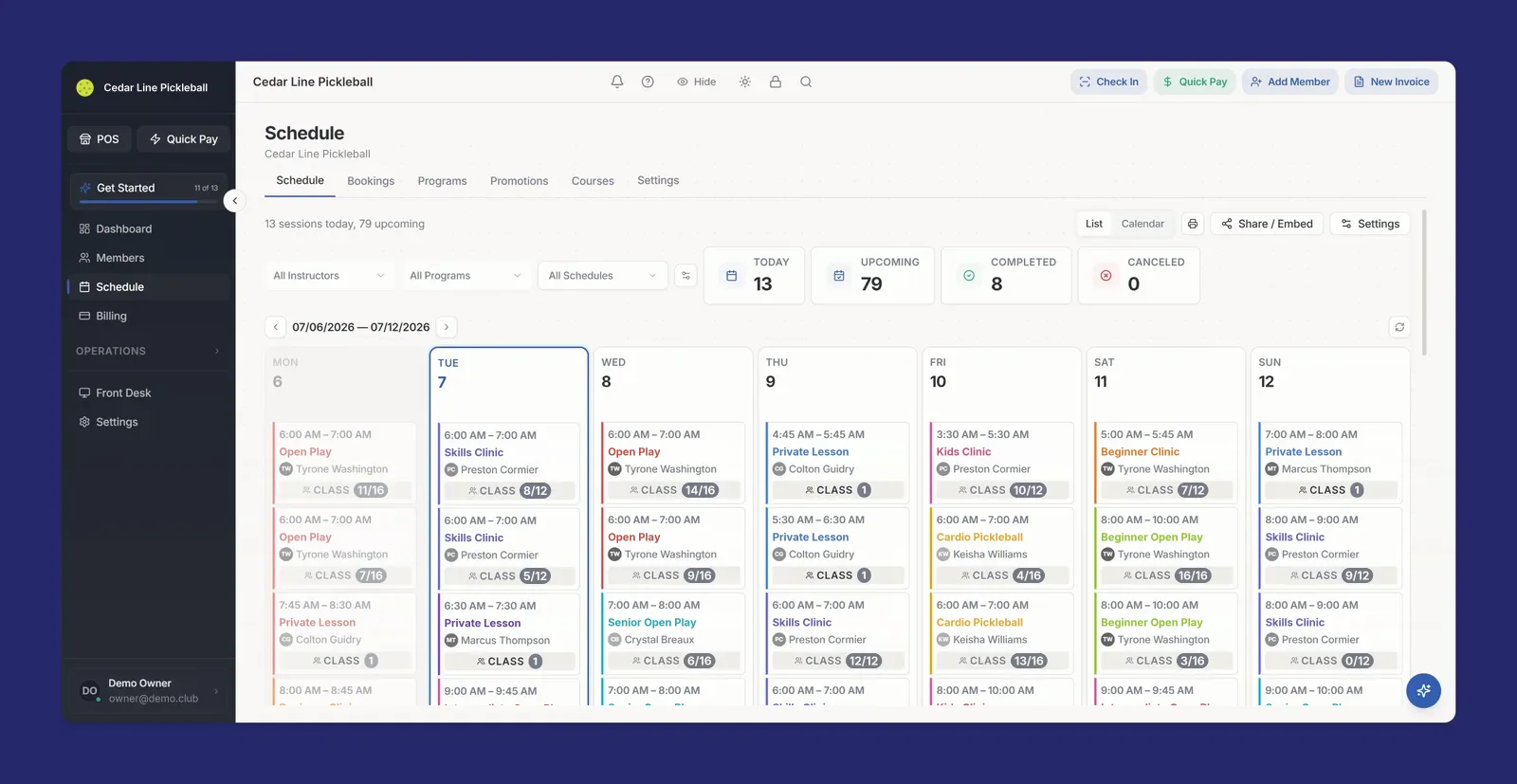
GymPoint's pickleball club software runs the club side of the business in one system. Memberships bill automatically, with family accounts, e-sign waivers and check-in. Open play runs as a scheduled session with a player cap, online booking and an optional waitlist, priced as a drop-in for non-members, members-only, or with passes and class packs. Private lessons run as appointments with a coach, and the point of sale sells paddles, balls and apparel.
Courts are booked through space rental. Each court has its own open hours, an hourly rate and an optional peak rate. Anyone books on your public booking page by the hour, in whole hours, with a card and no account, or the front desk books for them. Court rates are the same for members and everyone else, so build member value into open play, clinics and the membership itself. Two bookings can never overlap on the same court, and each confirmed booking gets a door code by email and text. Members get in through the Kisi integration. GymPoint does not run leagues, tournaments or ratings.
The Free plan is $0 a month with GymPoint Payments, and Growth and Pro are $39 and $99 a month. See pricing for card processing rates and plan details.
Frequently Asked Questions
How much does it cost to start a pickleball business?
It ranges from a few thousand dollars to convert a tennis court you already have to well over $1 million for an indoor club. Published indoor franchise investments run from $425,815 for Dill Dinkers to more than $2.4 million at the top of the ranges Entrepreneur lists for Pickleball Kingdom and Ace, which were last updated in 2022. Get local quotes for your site.
How much does it cost to build a pickleball court?
A standard outdoor acrylic court runs $20,000 to $35,000 per Legendary Sports Construction, and a high-quality court $35,000 to $80,000 per The Kitchen Pickleball. Converting warehouse space indoors runs $50,000 to $150,000 per court per 1st Source Lighting.
Are pickleball clubs profitable?
Some are. JDC Pickleball's benchmark club makes about $20,000 a month on $100,000 in revenue, and JDC puts break-even for a staffed club at $750,000 or more a year. Model a slow year before you commit.
Should I buy a pickleball franchise or open independently?
A franchise brings a brand and a playbook for a $50,000 to $60,000 fee plus 7% to 10% royalties and up to 2% more for a brand fund. Independents keep that margin but build their own systems.
How tall does an indoor pickleball ceiling need to be?
Builders recommend at least 18 ft, and at least 18 to 20 ft to the light fixtures. USA Pickleball does not set an official minimum.